


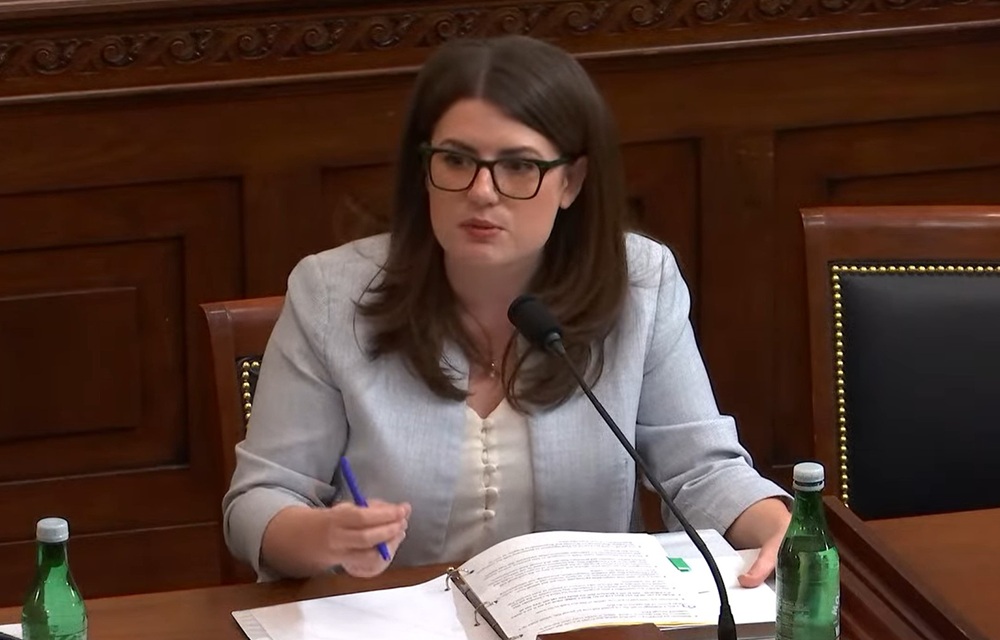
The U.S. House Committee on Natural Resources unanimously approved legislation designed to help foster a market for invasive blue catfish in pet food production during a 22 January markup session.
Initially introduced as a sportfish, blue catfish quickly spread throughout the Chesapeake Bay watershed. The voracious fish soon outcompeted local species, disrupting the fragile ecosystem in the bay.
“Invasive blue catfish in Maryland and Virginia’s Chesapeake Bay are threatening both the ecological and economic outcomes of our region,” U.S. Representative Sarah Elfreth (D-Maryland) said during the markup session. “If you see blue catfish in this region, please eat it. It’s nutritious. It’s delicious. It’s also incredibly invasive. It’s eating up baby oysters and rockfish and blue crabs – all the other things in the bay that we love. These invasive blue catfish, which have no natural predators, are just wreaking havoc across the bay.”
Government officials at the federal, state, and local levels have worked together and independently to remove as many of the fish as possible from the area’s waterways, transforming the invasive species into a valued fishery resource.
Introduced last summer by Elfreth and other regional lawmakers, the Mitigation Action and Watermen Support (MAWS) Act would continue that tradition.
“Having spent my life near the Chesapeake Bay, I understand how urgent it is that we protect the Bay’s delicate ecosystem from invasive blue catfish,” U.S. Representative Rob Whittman (R-Virginia) said in a social media post. “The MAWS Act will facilitate a new market for these fish – protecting the seafood industry from economic harm and preserving the health of the Bay. I am proud to join Congresswoman Elfreth in leading this piece of legislation as it passes out of committee, and I look forward to supporting it on the House Floor.”
The bipartisan legislation directs NOAA Fisheries to establish a three-year pilot program to provide grants that support the incorporation of blue catfish into pet and animal food manufacturers’ products.
“The market is not actually solving the problem itself. We have many that are below 1 or 2 pounds – or over 25 pounds – and it’s certainly a problem. So, this is an innovative solution, trying to open up a new market for these catfish in the pet food industry but also doing it in such a way that’s going to support our hardworking watermen,” Elfreth said. “It’s a model that could work if we prove its value, and there’s a lot of reporting language in this bill to do so.”
The legislation has been endorsed by Washington, D.C., U.S.A.-based The Pet Food Institute, which advocates for the nation’s pet food industry.
Elfreth also noted that, if successful, the program could be expanded to other regions with large catfish populations – or other invasive fish species.
“It could work in other parts of the country – folks along the Mississippi River who are experiencing invasive carp, for instance, or snakeheads,” Elfreth added. “It’s going to make a real impact, a real difference throughout the Chesapeake Bay, but could potentially have some great national implications.”
The House committee approved the bill unanimously, clearing it for consideration by the full House.
“Today, the Committee advanced important bipartisan legislation meeting challenges from the Grand Canyon to the Chesapeake Bay,” U.S. Representative Bruce Westerman (R-Arkansas) said in a release. “We approved innovative reforms to inform sailors and fishermen about water conditions and access and to respond to invasive catfish in the Chesapeake Bay. Today’s was a productive and bipartisan markup, and I look forward to bringing these bills to the House floor soon.”
link