


Detection of aflatoxins
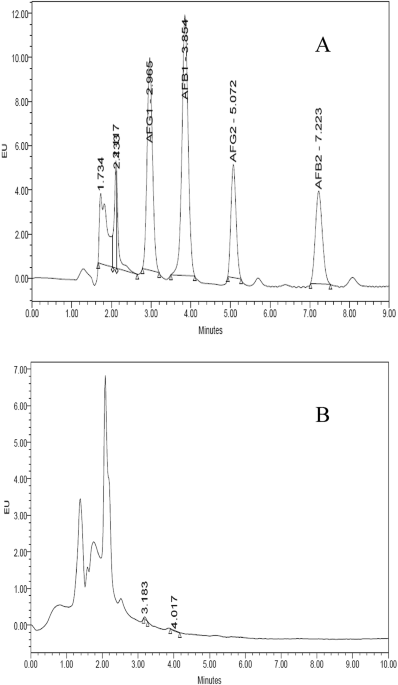
A toxicity test was performed to validate the selection of the fungal isolate with the maximum lipase production, in accordance with AOAC criteria20. The results shown in Fig. 1 (A and B) clearly showed that the fungus Aspergillus niger MK377324 produced no mycotoxins.

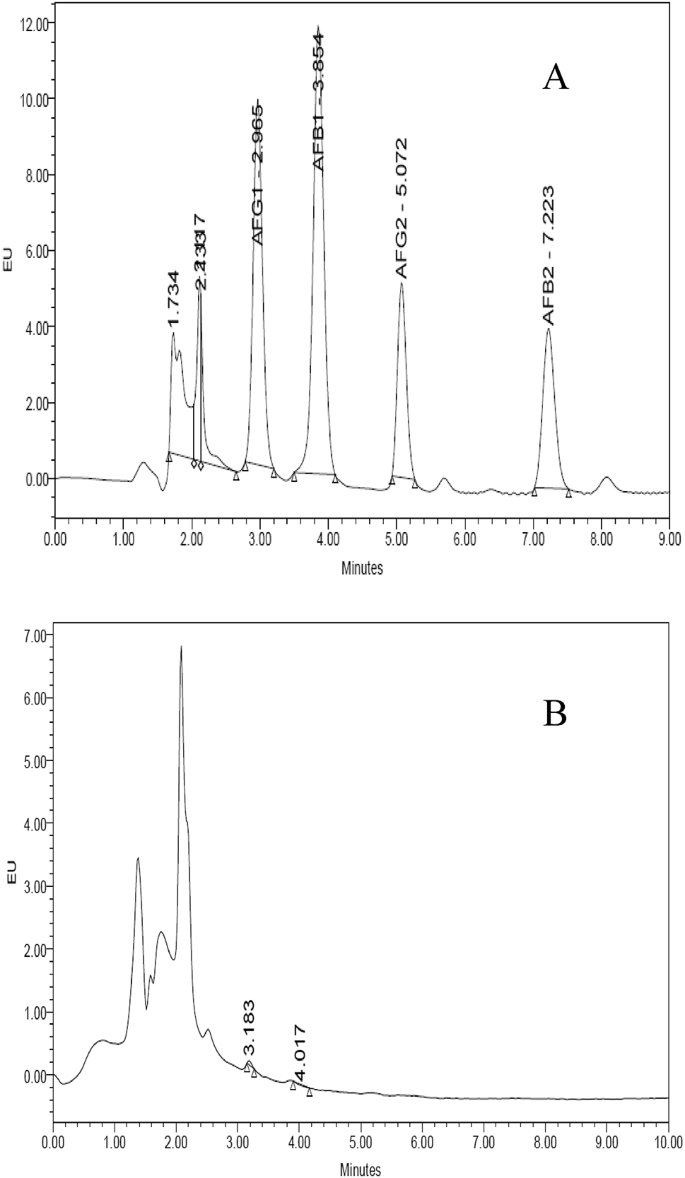
(A) Standard curve of aflatoxins; (B) Aflatoxins test for the highest lipase producer Aspergillus niger MK377324 using HPLC technique.
Multi-factor designs to improve lipase synthesis in A. niger MK377324
The current study shown that Aspergillus niger MK377324 produced the highest extracellular lipase of 4.83 ± 0.45 U/g ds when cultivated on cottonseed waste (60% moisture) at pH 7.0 for 6 days at 30 °C. Continuous optimization strategies were used to increase lipase production. The first strategy involves evaluating a large number of dietary characteristics to discover those that had a substantial influence on lipase production. The second strategy tried to maximize the quantities of these components in order to regulate lipase biosynthesis.
Characterization of fermentation parameters that affect lipase biosynthesis
A PB design was used to show the relevance of various nutritional components on lipase synthesis by Aspergillus niger MK377324 grown on cottonseed waste utilizing the solid state fermentation (SSF) technology. For evaluation, 11 medium components were chosen, and the average lipase values were obtained for each trial (Table 1). The impact of each parameter on lipase production was determined by comparing average data at high (+ 1) and low (− 1) levels. The data in Table 1 showed that the maximum and minimum lipase values were 16.39 ± 0.83 U/g ds and 2.05 ± 0.03, respectively, in runs 4 and 7, demonstrating the significant effect of medium constituents on lipase synthesis by A. niger when cottonseed waste was used as the substrate. The effect of each parameter on lipase synthesis was investigated further and represented in Fig. 2, which clearly shows that peptone, K2HPO4, CuSO4, and cottonseed waste had a beneficial effect on lipase biosynthesis, but MgSO4, KH2PO4, sucrose, and glucose had a negative impact.
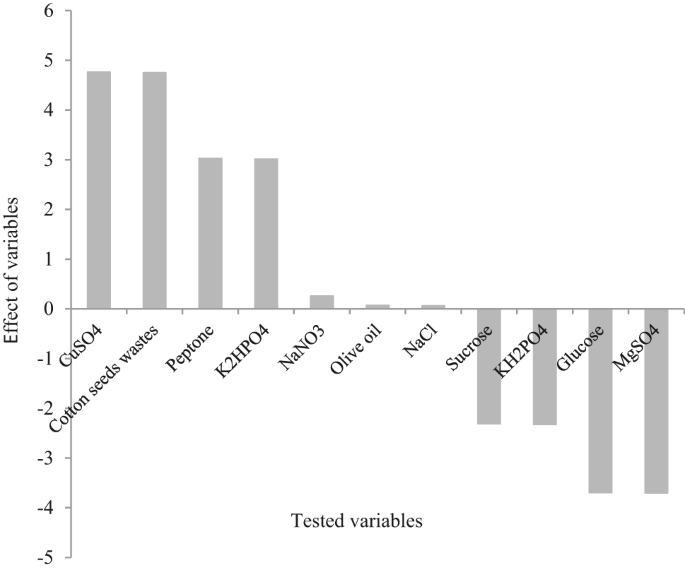
Pareto chart showing the effect of tested variables on lipase production by Aspergillus niger MK377324 using cottonseed waste as substrate under SSF.
The first linear order model, which illustrates the link between the eleven parameters and enzyme synthesis, is shown below:
Table 2 shows that CuSO4 had the highest effect, followed by cottonseed waste, peptone, and K2HPO4, as demonstrated by t-tests (0.58, 0.58, 0.37, and 0.37, respectively) and highly significant p-values (0.02, 0.02, 0.03, and 0.03, respectively). Based on our findings, it is feasible to use CuSO4, cottonseed waste, peptone, and K2HPO4 as essential parameters for further optimization using Central composite statistical design (CCD). Our findings exceed those of Salihu et al.25, who evaluated eleven medium components and identified Na2HPO4, (NH4)2SO4, MgSO4, Tween-80, sugar, and olive oil as positive contributions to total lipase synthesis, with a maximum production of 3.35 U/g. Furthermore, Rajendran and Thangavelu26 found that peptone, MgSO4.7H2O, KH2PO4, CaCl2.H2O and olive oil were beneficial variables in Rhizopus arrhizus producing the maximum lipase level of 3.98 U/mL. It is widely understood that glucose catabolic repression can impair lipase enzyme function in fungi such as Fusarium oxysporum, A. niger, Rhizopus delemar, and Rhizomucor miehei27. Mehta et al.15 investigated the effect of six variables on lipase production by A. fumigatus and observed that galactose, peptone, pH, and incubation time were important variables to consider in PB design. They concluded that 1.5% galactose, 1.8% peptone, a pH of 10.0, and a 72-h incubation period at 45 °C were appropriate under response surface curves, with a coefficient of determination (R2) of 0.9318 indicating that the model was significant.
Central composite statistical design
CCD was used to determine the optimal concentrations of the most important factors for lipase synthesis. Table 3 shows the coded and un-coded values of the four selected independent factors, the CCD program, and the observed and expected lipase yields. A multiple regression analysis of the experimental results produced the following second order polynomial equation:
$$\begin{aligned} {{\text{Y}}_{activity}} & ={\text{ }} – {\text{12}}.{\text{376}}\,+\,{\text{6}}.{\text{367}}{X_1}\,+\,0.{\text{281}}{X_2}\,+\,{\text{7}}.{\text{479}}{X_3} – {\text{55}}0.{\text{446}}{X_4}\,+\,0.{\text{138}}{X_1}^{{\text{2}}} \\ & \;\;\; – {\text{ }}0.{\text{145}}0{X_2}^{{\text{2}}}\,+\,0.0{\text{379}}{X_2}^{{\text{2}}}\,+\,{\text{3}}.{\text{489}}{X_3}^{{\text{2}}}\,+\,{\text{3}}0{\text{6}}{X_4}^{{\text{2}}} – {\text{ }}0.{\text{14}}0{X_1}{X_2} \\ & \;\;\; – {\text{2}}.{\text{714}}{{\text{X}}_{\text{1}}}{{\text{X}}_{\text{3}}} – {\text{ 3}}.{\text{226}}{X_1}{X_4}\,+\,0.{\text{8}}0{\text{9}}{X_2}{X_3}\,+\,{\text{61}}.{\text{976}}{X_2}{X_4} \\ & \;\;\; – {\text{ 343}}.{\text{287}}{X_3}{X_4} \\ \end{aligned}$$
Where Y activity: is the response (lipase production); X1, X2, X3, and X4: are the coded values of the variables examined (cottonseed waste, peptone, K2HPO4 and CuSO4, respectively).
The regression analysis of the CCD data enabled the creation of 3D response graphs revealing the interaction of the most significant variables in lipase production (Fig. 3 (A-F)). Similar to the findings of Mehta et al.15, the response surface graphs in Fig. 3 in our investigation showed a hill-shaped pattern, showing the presence of interactions between variables that led to maximal enzyme activity. Chien-Hung et al.28 discovered that the coefficient (R2) was 0.81, indicating that the model was significant with the lipase production values produced by Burkholderia sp. The ANOVA analysis findings (Table 4) revealed a substantial F-value (6.634), indicating that the statistical model is significant. Model terms with P > F (0.00001) values of less than 0.05 are considered important. The model’s quality was evaluated by computing the coefficient (R2) and the coefficient of correlation (R). The closer the R2 is to one, the more effective the model and greater the expected response. In the current investigation, the coefficient (R2) for lipase production was estimated to be 0. 861 (R2 > 0.75 denotes model adequacy), meaning that the statistical model can explain 86.1% of the response variation.
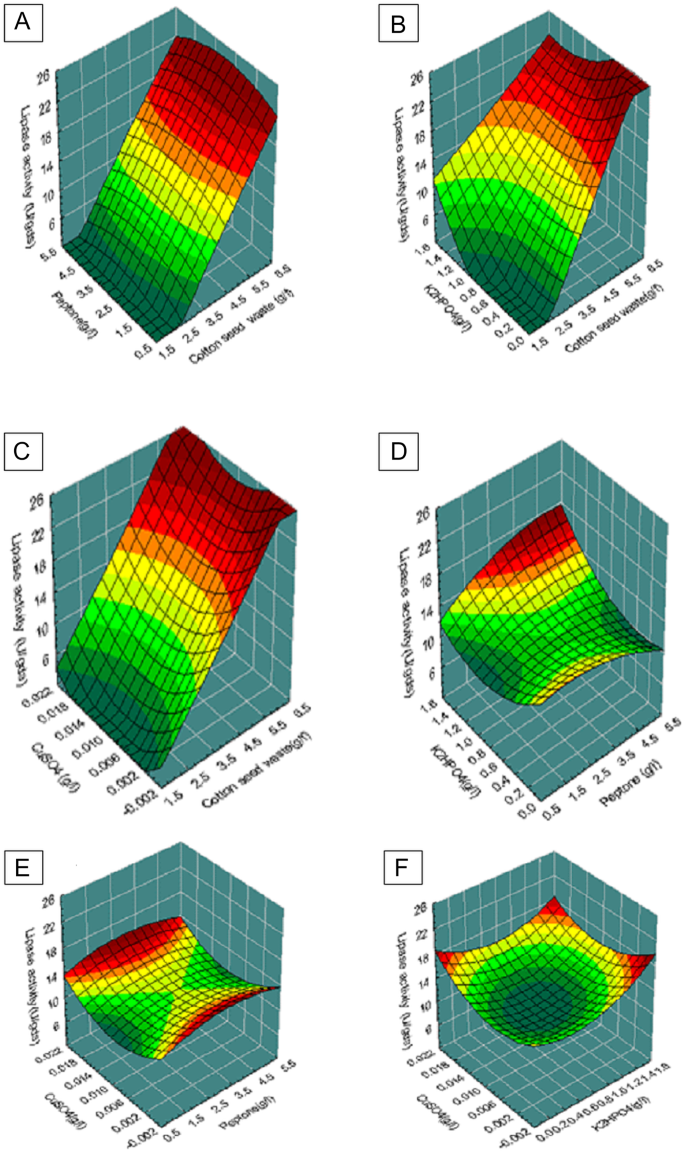
(A-F) Response surface plot of lipase production by Aspergillus niger MK377324 showing the interaction between different concentrations of: (A) cottonseed waste and peptone at X3 = 0 and X4 = 0; (B) cottonseed waste and K2HPO4 at X2 = 0 and X4 = 0; (C) cottonseed waste and CuSO4 at X2 = 0 and X3 = 0; (D) peptone and K2HPO4 at X1 = 0 and X4 = 0; (E) peptone and CuSO4 at X1 = 0 and X3 = 0; (F) K2HPO4 and CuSO4 at X1 = 0 and X2 = 0.
The biosynthesis of lipase increased by 4.4-fold when Aspergillus niger MK377324 was grown on cottonseed waste medium (pH 7.0) enriched with cottonseed waste, peptone, K2HPO4 and CuSO4 at concentrations of 5.0, 2.0, 0.5, and 0.015 g/L for 6 days at 30 °C using SSF. As a result, our data clearly proved the ability of A. niger to produce extracellular lipase under SSF conditions, as well as the proposed model’s effectiveness. In this concern Kaushik et al.29 reported that the maximal lipase activity achieved was 12.7 U/ml utilizing the CCD experiment for each individual run, as predicted29. Additionally, Al-Khattaf et al.30 found that the central composite design increased lipase synthesis by A. niger LP4 by 2.1-fold compared to the basal medium. The F-value of the constructed model was 12.98, with a p-value of 0.0002. Kaur and Gupta31 investigated extracellular lipase synthesis from a thermotolerant Bacillus subtilis TTP-06. ANOVA findings with a p-value of < 0.05 revealed an R2 value of 0.7846.
Evaluation of the residual biomass as nourishment for animals
Amino acid analysis
Table 5; Fig. 4 illustrate the amino acid content of cottonseed waste following Aspergillus niger MK377324 growth. According to this study, using cottonseed waste as a substrate resulted in a considerable increase in methionine (METH), therionine (THR), and lysine (LYS). The percentages of these amino acids were METH (0.44%), THR (1.04%), and LYS (1.28%).

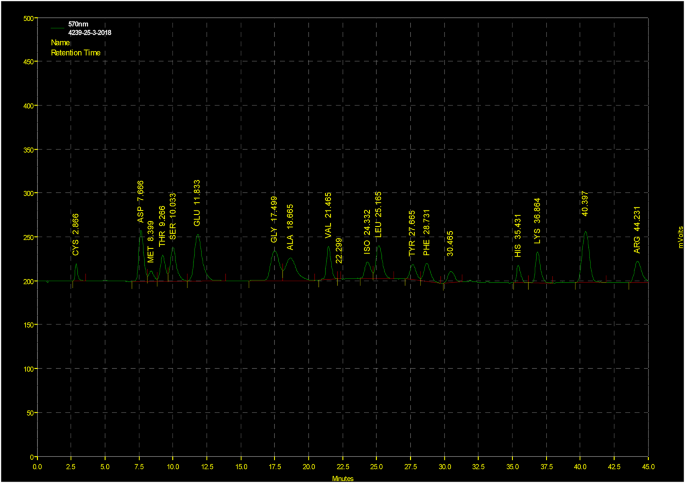
Amino acid analysis of cottonseed waste treated with Aspergillus niger MK377324.
Effect of fungal treatment on the chemical composition of cottonseed
Plant-derived metabolites containing natural antibiotics and health-promoting compounds can be used in feed additives. Cottonseed, a byproduct of the cotton plant (Gossypium spp.), is a promising source of fat and protein2. According to a pre-treatment chemical research, cottonseed waste can be used for animal and poultry nutrition. It includes 26.1% protein, 18.3% fiber, 51.3% carbohydrate, and only 4.3% ash. Low lignin content is particularly favorable to microbial growth and replication. The growth of Aspergillus niger MK377324 had a significant impact on the chemical composition of cottonseed waste based on dry weight, with treated waste having a higher percentage of protein and ash than untreated waste (Raw). The crude protein (CP) content of biologically processed cottonseed waste increased from 26.1 to 29.6% (Table 6). Animal feed is frequently supplemented with vitamins, trace elements, and minerals to improve its nutritional value. The supplementation of essential amino acids such as METH, LYS, and THR is critical for enhancing animal growth and productivity, resulting in more meat and milk production per kilogram of feed. This method helps to preserve precious plant resources. Global production of lysine for the feed operation exceeds one billion tons annually. Lysine synthesis through chemical means is not economically viable. Consequently, biotechnologists have engineered microorganisms to synthesis amino acids on an industrial scale. This is done in large steel containers where the bacteria can multiply under ideal conditions32.
Improving feed efficiency in pigs by the dietary use of amino acids is becoming increasingly important. This approach not only provides an appropriate supply of plasma amino acids for muscle growth, but it also lowers nitrogen release into the environment via urine and feces. Lysine, the first restricted amino acid in standard pig nutrition, acts as an intermediary in the production of body proteins, peptides, and non-peptide substances. Lysine is broken down in abundance to provide energy. Lysine is essential for controlling amino acid metabolism and can affect the metabolism of other nutrients30. The CP content is consistent with that of Iyayi and Aderolu33, who found an increase in CP levels in agro-wastes treated with Trichoderma viride. Furthermore, Dhanda et al.34 found that biological treatment enhanced the CP content of spent straw from 3.42 to 6.19%. Dietary fiber is made up of non-starch polysaccharides such as arabinoxylans, cellulose, and many other plants, including resistant dextrins, inulin, waxes, chitins, pectins, glucan, and oligosaccharides, which are considered to be anti-nutritional for many animals. Cellulases successfully hydrolyze cellulose in feed ingredients, converting it into a readily absorbable substance that improves animal health and performance35. According to Karau and Grayson36, proteins are made up of twenty amino acids. Some of these, known as essential amino acids, must be included in animal feed since animals cannot produce them. The essential amino acids may differ depending on the species. Feeds must provide essential amino acids in sufficient quantities and meet the livestock’s needs in order to maintain maximum health and growth performance. Cottonseed waste has been identified as a promising source of proteinaceous nutrients as a result of the growing emphasis on cost reduction in industrial operations and the need to add value to agro-industrial residues. It can serve as a support matrix for a variety of biotechnological operations. As a result, cottonseed waste can be used as an alternative feedstock in ruminant diets to reduce pollution and feeding expenses. As a consequence, A. niger MK377324 treatment of cottonseed waste can improve its nutritional value while having no effect on animal performance since the nutrient content of the treated cottonseed waste was improved by increasing total protein, decreasing crude fibers, and increasing total energy.
link