



Europe Acids and Nutrients in Animal Nutrition Market Size
The European acids and nutrients in animal nutrition market was valued at USD 3.83 billion in 2024 and is anticipated to reach USD 3.97 billion in 2025 to USD 5.27 billion by 2033, growing at a CAGR of 3.60% during the forecast period from 2025 to 2033.


Acids and nutrients in animal nutrition includes organic and inorganic acids amino acids vitamins minerals and specialty additives integrated into livestock and aquaculture feed to enhance growth immunity gut health and feed efficiency. These functional compounds serve as alternatives to antimicrobial growth promoters following the European Union’s complete ban on antibiotic use for growth purposes enacted in 2006. In recent years, the European livestock sector has intensified its reliance on precision nutrition to meet stringent food safety and sustainability benchmarks. According to Eurostat, the European Union produced tens of millions of metric tons of pig and poultry meat in 2024, reflecting substantial demand for high‑quality feed additives. The European Food Safety Authority (EFSA) has reinforced the necessity of organic acids such as formic and propionic acid in controlling pathogens like Salmonella in poultry feed, citing their role in reducing zoonotic transmission risks. Concurrently, the European Commission’s Farm to Fork Strategy targets a 25% reduction in nutrient losses by 2030, which is prompting reformulation of feed with highly bioavailable trace minerals and amino acid profiles. This regulatory and production landscape establishes acids and nutrients as indispensable components in Europe’s evolving animal nutrition paradigm, where food safety, sustainability, and productivity converge to shape the future of livestock production.
MARKET DRIVERS
Stringent Regulations Against Antibiotic Growth Promoters Accelerate Adoption of Functional Acids
The European Union’s prohibition of antibiotic growth promoters since 2006 remains a foundational driver for the sustained integration of organic acids into animal feed and is one of the major factors propelling the European acids and nutrients in animal nutrition market growth. According to the European Medicines Agency, antibiotic sales across the EU decreased by roughly one third between 2011 and 2023, yet pressure to curb resistance persists. Organic acids such as formic citric and lactic acid disrupt pathogenic bacterial membranes and lower gut pH thereby enhancing nutrient absorption and suppressing Salmonella and E coli colonization. As per EFSA, dietary inclusion of formic acid at around 0.5% has been shown to reduce Salmonella prevalence in broiler ceca by up to about 60% in controlled trials. National action plans under the EU One Health AMR Strategy have further incentivized acid-based solutions with countries like Denmark and the Netherlands mandating acidifiers in all post weaning piglet diets. Feed manufacturers across Germany and France now routinely formulate starter feeds with acid blends meeting EFSA safety dossiers ensuring regulatory and market compliance. This policy induced shift has institutionalized acids as non-negotiable components in European animal nutrition protocols.
Rising Demand for High Quality Animal Protein Fuels Precision Nutrient Supplementation
Europe’s consistent per capita consumption of animal protein drives the need for optimized feed efficiency through targeted nutrient delivery, which is further boosting the European acids and nutrients in animal nutrition market growth. Synthetic amino acids like lysine threonine and methionine enable ideal protein balancing reducing nitrogen excretion while maximizing muscle deposition. The European Commission’s Integrated Pollution Prevention and Control guidelines encourage amino acid supplementation to lower crude protein content in feed thereby cutting ammonia emissions from livestock housing. In 2023, the European Union imported over roughly one point two million metric tons of soybean meal primarily for poultry and swine diets as per Eurostat yet rising costs and sustainability concerns have amplified reliance on synthetic amino acids to offset protein variability. As per the projections of the European Feed Manufacturers Federation, over 85% of compound feed in Western Europe now includes at least three synthetic amino acids. Furthermore, the EU’s Green Deal commitments have accelerated adoption of chelated trace minerals such as zinc and copper amino acid complexes which improve bioavailability by about thirty to 50% compared to inorganic salts as validated by peer reviewed studies from Wageningen University. This convergence of nutritional science environmental policy and consumer expectations solidifies precision nutrients as core enablers of Europe’s protein supply chain.
MARKET RESTRAINTS
Volatility In Raw Material Prices Disrupts Cost Stability of Acid and Nutrient Formulations
The production of organic acids and synthetic amino acids depends heavily on petrochemical and fermentation feedstocks whose prices fluctuate with global energy markets and agricultural commodity cycles, which is a notable restraint to the growth of the European acids and nutrients in animal nutrition market. As per the European Chemical Industry Council the price of methanol increased by around 40% between January 2022 and December 2023 due to natural gas supply constraints following geopolitical tensions. Similarly, lysine production relies on corn and sugar beet feedstocks with European sugar beet yields declining by about 12% in 2023 according to Eurostat owing to adverse weather patterns. These instabilities directly inflate feed additive costs which cannot be fully passed to farmers operating on thin margins. According to the European Livestock Farmers Association, in early 2024, roughly 60% of pig and poultry producers reduced inclusion rates of premium acid blends during price spikes opting for lower efficacy alternatives. This cost sensitivity hampers consistent application of optimal nutritional strategies particularly among small and medium scale farms in Southern and Eastern Europe. Consequently, feed manufacturers struggle to maintain formulation consistency undermining the long-term health and performance outcomes acids and nutrients are designed to deliver.
Complex And Fragmented Regulatory Approval Processes Across Member States
Although the European Union operates under centralized feed additive authorization via Regulation EC 1831 2003, national interpretations and enforcement create practical barriers to uniform product adoption, which is further hampering the European acids and nutrients in animal nutrition market growth. As per the European Commission’s 2024 review of feed additive dossiers, over roughly 30% of novel acid-based formulations faced delays exceeding 18 months due to divergent risk assessments by member state competent authorities. For instance, while Germany’s Federal Office of Consumer Protection swiftly endorsed a new buffered propionic acid blend in 2023 the same product awaited approval in Italy and Spain pending additional local toxicology studies. Moreover, post authorization compliance varies with France requiring batch specific certificates of analysis while Poland mandates on site audits for imported nutrient premixes. This regulatory fragmentation increases time to market and compliance costs particularly for specialty nutrient suppliers lacking localized regulatory expertise. According to the European Feed Additives Association, smaller innovators often withdraw from markets like Greece and Romania due to disproportionate administrative burdens. Such inconsistencies impede innovation diffusion and reduce accessibility to next generation acids and nutrients despite their scientific validation at the EU level.
MARKET OPPORTUNITIES
Integration Of Circular Bioeconomy Principles Enables Sustainable Acid Production
Europe’s transition toward a circular bioeconomy is a significant opportunity to the European acids and nutrients in animal nutrition market growth. As per the European Environment Agency, over 90 million metric tons of biowaste are generated annually by the EU food industry, which is creating a viable substrate for bio-based acid fermentation. Companies in the Netherlands and Finland have pioneered pilot plants converting potato peels and whey permeate into lactic and acetic acids using engineered microbial strains. In 2023, the European Institute of Innovation and Technology funded a cross-border consortium to scale formic acid production from lignocellulosic biomass achieving roughly a forty% reduction in carbon footprint compared to petrochemical routes. The European Commission’s Horizon Europe program allocated about 65 million euros in 2024, specifically for bio-based feed additives under its Climate Neutral Food Systems initiative. Feed mills in Sweden and Denmark have already trialed these circular acids in piglet diets with performance parity to conventional sources. This convergence of waste valorisation decarbonization and regulatory support positions bio derived acids as a transformative growth vector in Europe’s animal nutrition sector.
Expansion Of Precision Livestock Farming Drives Demand for Smart Nutrient Delivery Systems
The rapid adoption of precision livestock farming technologies across Europe creates fertile ground for advanced nutrient delivery platforms tailored to individual animal needs, which is a promising opportunity for the European acids and nutrients in animal nutrition market growth. As per the European Commission’s Digital Europe Programme, over 45% of large-scale dairy and poultry operations now use sensor-based monitoring systems tracking feed intake health markers and growth rates in real time. This data enables dynamic feed formulation where amino acid and acid dosages are adjusted daily based on physiological status. In Germany, a 2024 trial by the Thünen Institute demonstrated that layer hens receiving real time adjusted methionine and citric acid blends improved eggshell strength by about 19% and reduced feed conversion ratio by roughly 0.18 points. Feed additive manufacturers are responding by developing microencapsulated acids and amino acids that release actives at targeted gut sites enhancing efficacy and reducing required inclusion rates. The European Federation of Animal Science advocates for integrating these smart nutrients into digital feed platforms to meet Farm to Fork efficiency targets. As connectivity and AI analytics mature this synergy between digital agriculture and functional nutrition will unlock unprecedented levels of feed precision and sustainability.
MARKET CHALLENGES
Consumer Skepticism Toward Feed Additives Despite Scientific Validation
Despite rigorous safety assessments by the European Food Safety Authority persistent consumer mistrust of synthetic feed additives hampers market expansion. As per the 2024 Eurobarometer survey on food safety roughly thirty% of European consumers expressed concern that “artificial ingredients in animal feed” compromise meat and dairy quality even when EFSA confirms no residue transfer. This perception influences retailer policies with major supermarket chains in the UK and France adopting “free from synthetic additives” labeling for private label poultry and pork. Consequently, integrators and feed mills avoid using visible additives such as crystalline amino acids or coloured acid blends even when nutritionally optimal. The European Consumer Organisation notes that misinformation on social media linking feed acids to antibiotic resistance has amplified public anxiety. This disconnects between regulatory science and consumer sentiment forces producers to choose between nutritional excellence and marketability particularly in premium and organic segments. Until transparent communication strategies bridge this knowledge gap the full potential of acids and nutrients will remain constrained by perception rather than evidence.
Limited Technical Expertise in Feed Formulation Among Small Scale Producers
While large integrators in Western Europe leverage advanced nutritional modeling, the majority of Europe’s livestock farms remain small scale with limited access to feed formulation expertise, which is further challenging the European acids and nutrients in animal nutrition market expansion. As per Eurostat, 76% of EU farms are classified as small holdings with fewer than ten livestock units and often rely on generic compound feeds or self-mixing. These operations rarely adjust acid or amino acid inclusion based on ingredient variability or animal stage leading to suboptimal performance and excess nutrient excretion. According to a 2023 study by the University of Ghent, only about 28% of pig farmers in Romania and Bulgaria used balanced amino acid profiles despite high soybean meal inclusion resulting in nitrogen waste up to roughly 30% above recommended levels. Extension services remain underfunded with the European Agricultural Knowledge and Innovation Systems allocating less than five% of its budget to on farm nutrition training. Without targeted capacity building the benefits of precision acids and nutrients will remain inaccessible to a significant portion of Europe’s farming community thereby limiting sector wide efficiency and environmental gains.
REPORT COVERAGE
|
REPORT METRIC |
DETAILS |
|
Market Size Available |
2024 to 2033 |
|
Base Year |
2024 |
|
Forecast Period |
2024 to 2033 |
|
CAGR |
3.60% |
|
Segments Covered |
By Type, Application, And & Region |
|
Various Analyses Covered |
Global, Regional & Country Level Analysis, Segment-Level Analysis, DROC, PESTLE Analysis, Porter’s Five Forces Analysis, Competitive Landscape, Analyst Overview on Investment Opportunities |
|
Regions Covered |
UK, France, Spain, Germany, Italy, Russia, Sweden, Denmark, Switzerland, Netherlands, Turkey, Czech Republic & Rest of Europe |
|
Market Leaders Profiled |
Adisseo France S.A.S, Archer Daniels Midland Company, BASF SE, Cargill Incorporated, Charoen Pokphand Foods Pcl., Royal DSM N.V., Evonik Industries AG, and Nutreco N.V., Alltech, Novus International Inc. |
SEGMENTAL ANALYSIS
By Type Insights
The amino acids segment accounted for the dominating share of the Europe acids and nutrients in animal nutrition market in 2024. The dominance of amino acids segment in the European market is attributed to the critical role of synthetic amino acids, particularly lysine, methionine, threonine, and valine to enable low protein diets that comply with environmental regulations while maintaining animal performance. The European Union’s National Emission Ceilings Directive mandates ammonia reduction from agriculture, and amino acid balancing underpins protein optimization strategies in commercial feed formulations. By balancing dietary amino acids farmers can lower crude protein levels in feed while maintaining animal performance, an approach broadly supported by EU sustainability strategies and university research. Germany’s feed sector integrates industrial‑scale amino acids across swine and poultry rations, consistent with regional growth benchmarks reported for Europe’s amino acid market. Furthermore, the European Commission’s updated guidelines on feed additives in 2023 reaffirmed the safety and efficacy of crystalline amino acids under Regulation EC 1831/2003, which is facilitating seamless adoption.
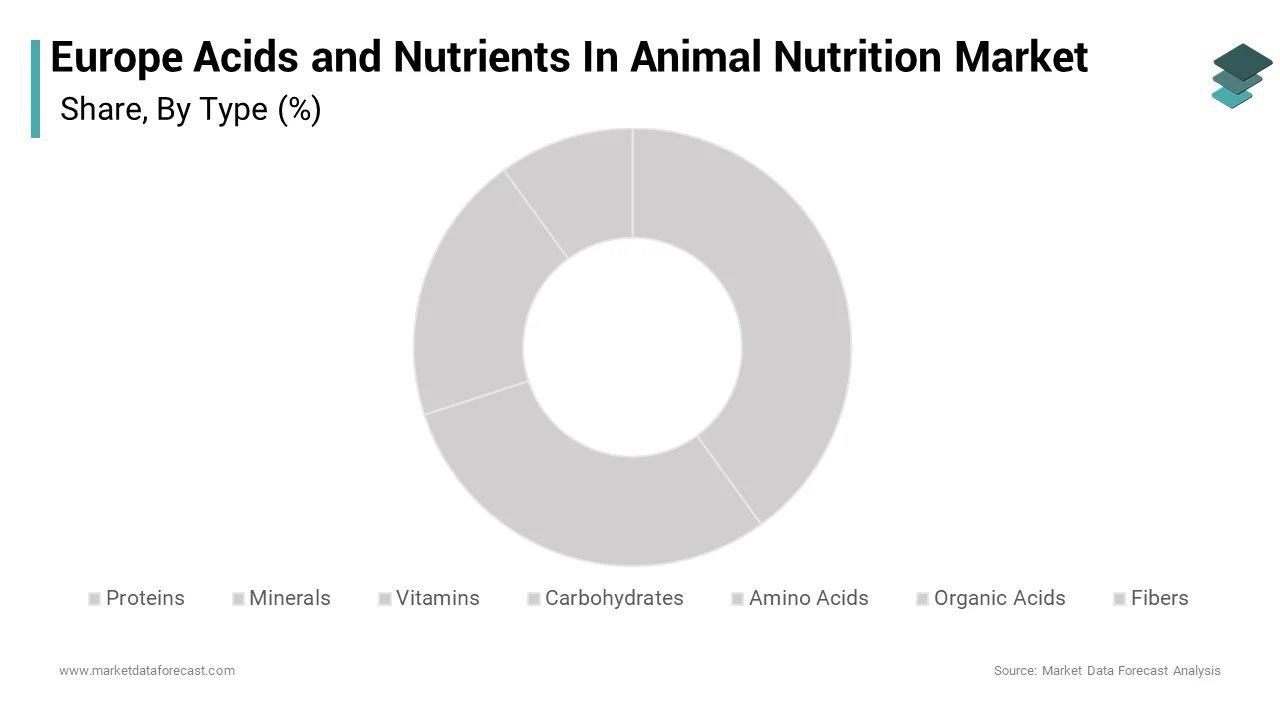
The organic acids segment represents the fastest growing type segment in the Europe acids and nutrients in animal nutrition market and is estimated to showcase a CAGR of 9.04% over the forecast period. The strong regional demand across applications including animal feed, intensifying efforts to replace antibiotic growth promoters and enhance gut health in post weaning livestock are fuelling the expansion of the organic acids segment in this regional market. Formic, propionic, and benzoic acids are now standard in piglet and broiler starter feeds across Western Europe due to their proven efficacy in suppressing enteric pathogens. A growing body of EU safety assessments supports acidifier inclusion for pathogen control and feed efficiency, in line with antimicrobial resistance strategies. National action plans under the EU One Health AMR Strategy have further institutionalized acid use in starter diets. Additionally, innovations in buffered and microencapsulated acid formulations have improved palatability and targeted release in the lower gut enhancing efficacy without feed intake suppression. As feed mills in Spain and Poland modernize to meet Farm to Fork hygiene standards demand for stabilized acid solutions continues to surge, making this segment the most dynamic in the European nutritional additives landscape.
By Application Insights
The poultry feed segment commanded for the leading share of the European acids and nutrients in animal nutrition market in 2024 owing to the Europe’s high poultry meat and egg consumption coupled with intensive production systems that rely on precision nutrition for efficiency and biosecurity. The European Union produced substantial volumes of poultry meat in 2023 with broilers accounting for the majority of compound feed demand. Given the complete ban on antibiotic growth promoters since 2006 poultry integrators have become early adopters of organic acids and amino acid balancing to maintain flock health and growth rates. EU risk assessments continue to emphasize Campylobacter and Salmonella control, supporting acidifier uptake in commercial broiler feeds. Furthermore, the short production cycle of broilers makes nutritional optimization critical with even minor feed efficiency gains yielding significant economic returns. This operational urgency combined with stringent food safety requirements ensures poultry remains the primary application vector for advanced acids and nutrients across Europe.
The aqua feed segment is the fastest growing application segment in the Europe acids and nutrients in animal nutrition market and is expected to record a CAGR of 6.05% over the forecast period. The expansion in salmon, trout, and seabass production and nutritionally advanced feed adoption, Europe’s strategic push to enhance domestic seafood production and reduce import dependency that are supported by EU aquaculture guidelines are supporting the growth of the aqua feed segment in the European market. The European Commission’s Strategic Guidelines target increased farmed fish output by 2030, which is demanding for advanced nutritional solutions for species like sea bass, trout, and salmon. Unlike terrestrial animals fish lack a stomach and exhibit limited enzymatic capacity making exogenous acidifiers and highly digestible amino acids essential for nutrient utilization. Controlled trials in European aquaculture consistently report improvements in mineral retention and growth performance with acidifier inclusion, aligning environmental and productivity objectives. Moreover expanding land‑based recirculating aquaculture systems in Northern Europe drive demand for water‑stable acid and nutrient premixes, accelerating adoption in the segment
COUNTRY ANALYSIS
Germany Acids And Nutrients In Animal Nutrition Market Analysis
Germany accounted for 20.2% of the Europe acids and nutrients in animal nutrition market share in 2024 and stood as the top performer in this regional market. The dominance of Germany in the European market arises from its massive livestock inventory including over 27 million pigs and one hundred ten million poultry birds as reported by the Federal Statistical Office. Germany operates the most advanced compound feed infrastructure in Europe producing over 24 million metric tons annually with near universal adoption of amino acid balancing and organic acid inclusion. According to the Umweltbundesamt, national ammonia emission controls under the German National Air Pollution Control Programme compel feed mills to formulate lower‑protein rations fortified with synthetic lysine and threonine. Furthermore, Germany hosts multiple global additive manufacturers and research institutes such as the Friedrich Loeffler Institute which continuously validate new acid and nutrient technologies. As per the German Feed Ordinance, 2023 amendments streamlined approval pathways for microencapsulated organic acids, accelerating commercial deployment. This blend of regulatory pressure industrial scale and scientific rigor cements Germany’s leadership in functional animal nutrition.
France Acids And Nutrients In Animal Nutrition Market Analysis
France held a promising share of the Europe acids and nutrients in animal nutrition market in 2024. The vertically integrated poultry and swine sectors of France is majorly driving the French market growth. The country produces over 2 million metric tons of poultry meat annually with leading cooperatives like LDC and Terrena controlling feed formulation from grain to retail. This integration enables consistent deployment of organic acid blends and vitamin mineral premixes across millions of birds. According to the Ecophyto III plan, France targets a 50% reduction in antimicrobial use in livestock by 2025, prompting nationwide adoption of acidifiers as gut health promoters. As per ANSES, post‑weaning piglet feeds commonly include formic or propionic acid to support digestive health and reduce antimicrobial reliance. Additionally, France is a pioneer in trace mineral innovation with chelated zinc and copper now standard in breeder rations to enhance immunity and reduce environmental loading. National research institutions like INRAE continuously publish validation data supporting these practices ensuring scientific credibility and farmer trust.
Netherlands Acids And Nutrients In Animal Nutrition Market Analysis
The Netherlands is anticipated to account for a prominent share of the European acids and nutrients in animal nutrition market over the forecast period due to its world leading focus on emission reduction and circular feed systems. Despite having only sixteen million pigs the country produces over twelve million metric tons of compound feed annually with some of the highest inclusion rates of synthetic amino acids in Europe. According to the Dutch Nitrogen Action Programme, a mandated reduction in livestock nitrogen deposition by 2030 compels feed mills to adopt ideal protein models using lysine methionine and threonine to minimize crude protein content. As per Wageningen University, Dutch poultry feeds have reduced average crude protein content over the past decade while maintaining growth performance through precise amino acid supplementation. The Netherlands also leads in organic acid innovation with buffered blends designed for low water solubility to suit pelleted feed processing. Strong collaboration between feed producers, additive suppliers and environmental agencies ensures continuous alignment of nutrition strategies with national sustainability targets.
Spain Acids And Nutrients In Animal Nutrition Market Analysis
Spain is predicted to register a healthy CAGR in the Europe acids and nutrients in animal nutrition market during the forecast period. The status of Spain as the EU’s largest poultry producer with over one billion birds slaughtered annually is one of the factors driving the Spanish market growth. The rapid expansion of integrated poultry complexes in regions like Castilla y León and Catalonia has intensified demand for gut health solutions including organic acids and vitamin premixes. According to the PRAN plan, Spain requires a thirty% decline in veterinary antibiotic use by 2025, accelerating substitution with acidifiers in starter feeds. As per the Spanish Agency for Medicines and Health Products, commercial broiler feeds widely include citric or lactic acid blends to support performance and food safety targets. Additionally rising soybean meal prices have prompted greater use of synthetic amino acids to maintain protein balance amid fluctuating raw material quality. Feed mills serving major exporters like Avex and Coren have invested in real time nutrient analysis systems ensuring precise additive dosing. This production scale and regulatory impetus position Spain as a high-volume growth market for functional nutrition.
Denmark Acids And Nutrients In Animal Nutrition Market Analysis
Denmark is estimated to grow at a notable CAGR in Europe acids and nutrients in animal nutrition market during the forecast period owing to its globally recognized leadership in antimicrobial free pig production. The Danish Pig Production system has operated without antibiotic growth promoters since 1998 and now achieves weaning to slaughter mortality rates below four% through advanced nutritional management. According to the Danish Agriculture and Food Council, national guidelines require organic acids in post‑weaning piglet diets to support gut health and reduce therapeutic antibiotic need. As per industry disclosures, Danish feed mills incorporate substantial volumes of organic acids into piglet feed each year to meet program requirements. Denmark also pioneered the use of protected amino acids that resist degradation in pelleting enhancing delivery to the small intestine. The country’s stringent Salmonella control program mandates acid treatment of feed ingredients further driving additive penetration. Continuous public private research through institutions like SEGES ensures scientific validation and rapid adoption of next generation nutrient solutions making Denmark a benchmark for functional animal nutrition in Europe.
COMPETITIVE LANDSCAPE
The Europe acids and nutrients in animal nutrition market is characterized by intense competition among globally established specialty chemical and nutrition companies with deep scientific expertise and regulatory experience. The landscape is not price driven but rather shaped by innovation in product efficacy sustainability and digital integration. Leading firms differentiate through proprietary fermentation processes stabilized acid formulations and bioavailable trace minerals backed by peer reviewed research. Regulatory complexity under Regulation EC 1831 2003 creates high entry barriers favoring incumbents with established dossier infrastructure. Nevertheless regional players in Eastern Europe are emerging through niche organic acid blends targeting local livestock systems. Competition increasingly centers on environmental performance with companies competing on nitrogen and phosphorus reduction metrics validated by independent bodies. Strategic partnerships with feed mills integrators and research universities are critical to maintain relevance amid evolving EU sustainability mandates. The market rewards those who combine scientific rigor with practical on farm applicability.
KEY MARKET PLAYERS
Some of the major companies dominating the market, by their products and
- services Adisseo France S.A.S
- Adisseo France SAS
- DSM Nutritional Products AG
- Archer Daniels Midland Company
- BASF SE
- Cargill Incorporated
- Charoen Pokphand Foods Pcl
- Royal DSM N.V.
- Evonik Industries AG
- Nutreco N.V.
- Alltech
- Novus International Inc.
Top Players In The Market
- Adisseo France SAS is a global leader in feed grade amino acids and specialty nutrients with deep integration across Europe’s animal nutrition value chain. The company supplies methionine lysine and hydroxy analogues to major feed integrators and premix manufacturers throughout the region. In 2024 Adisseo expanded its production capacity for liquid methionine at its Antwerp facility to meet rising demand for low protein swine and poultry diets aligned with EU ammonia reduction targets. The firm also launched its Selsaf selenium enriched yeast platform across Nordic countries enhancing immune support in ruminants. Its R&D center in France collaborates with INRAE to validate next generation organic acid combinations focused on gut health without impacting feed palatability.
- Evonik Industries AG plays a pivotal role in the Europe acids and nutrients in animal nutrition market through its comprehensive portfolio of essential amino acids including Biolys lysine and MetAMINO methionine. The company leverages proprietary fermentation technology to ensure high purity and sustainability in production. In late 2023 Evonik inaugurated a new digital feed formulation platform called AMINONIR Connect enabling real time adjustment of amino acid dosing based on raw material variability across European feed mills. The firm also strengthened its organic acids pipeline by initiating field trials for a buffered benzoic acid formulation designed for pelleted broiler feed in Southern Europe. These initiatives reinforce Evonik’s commitment to precision nutrition and emission reduction.
- DSM Nutritional Products AG contributes significantly to European animal nutrition through its vitamins organic acids and eubiotics portfolio under the Delvo and Vevo brands. The company’s focus on gut health solutions has driven adoption of its VevoVital benzoic acid and DelvoZyme phytase systems in poultry and swine rations. In early 2024 DSM launched a circular feed initiative in the Netherlands converting food industry byproducts into bio based organic acids for animal feed. The firm also enhanced its vitamin stability technologies to withstand high temperature pelleting processes common in Central Europe. Collaborations with Wageningen University on trace mineral bioavailability further solidify DSM’s scientific leadership in sustainable nutrient delivery.
Top Strategies Used by the Key Market Participants
Key players in the Europe acids and nutrients in animal nutrition market prioritize regulatory alignment with EU feed additive frameworks to ensure timely product authorization and compliance. They invest in sustainable production methods including bio based fermentation and circular feedstock sourcing to meet Farm to Fork environmental targets. Companies develop digital formulation tools that enable real time nutrient balancing based on ingredient variability and animal requirements. Strategic collaborations with national research institutes validate efficacy and support health claims for novel acid and nutrient blends. Product innovation focuses on stabilization microencapsulation and targeted release to enhance performance in pelleted and extruded feeds. Firms also tailor portfolios by livestock segment with specialized solutions for aquaculture and ruminants gaining prominence. Finally they expand technical service networks to support small and medium scale farmers in adopting precision nutrition practices across diverse European regions.
SEGMENT ANALYSIS
This research report on the Europe acids and nutrients in animal nutrition market is segmented and sub-segmented into the following categories.
By Type
- Proteins
- Minerals
- Vitamins
- Vitamin A
- Vitamin E
- Vitamin B2
- Vitamin C
- Carbohydrates
- Amino Acids
- Organic Acids
- Fibers
Amino acids are the major segment that contributes to the growth of the market.
By Application
- Ruminant Feed
- Poultry Feed
- Aqua feed
- Swine Feed
- Equine Feed
- Other Livestock Types
By Country
- UK
- France
- Spain
- Germany
- Italy
- Russia
- Sweden
- Denmark
- Switzerland
- Netherlands
- Turkey
- Czech Republic
- Rest of Europe
link