


Leger/Allstate Canada survey reveals many Canadian drivers may be unknowingly putting pets at risk

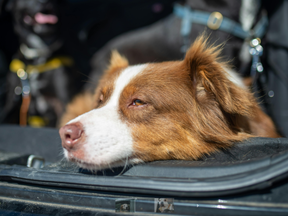
Article content
Whether you’re packing up for a road trip with the family or just going on an errand in the car, don’t forget about the safety of your fur babies, too.
Advertisement 2


Article content
With Responsible Dog Ownership Day coming up next Saturday, a new Leger and Allstate Canada survey revealed that many Canadians may be unknowingly putting their beloved dogs and cats at risk in their vehicles.
Article content
Article content
Even though 84% of dog and cat owners drive with their pets at least yearly, just 50% use restraints such as harnesses attached to a seatbelt (12%) or crates (32%) and 47% said their pets are unprotected in the event of a crash.
“I wouldn’t chalk it up to not caring about animals,” said George Ljubicic, agency manager for Allstate Insurance Company of Canada.
“I think they’re just forgetting that these safety features are important because people haven’t had something unfortunate happen and when it does, and it’s very serious, that’s when people kind of learn. I think it’s more educating the public around the risks with this because they might not experience it until, God forbid, something happens.”


Your Midday Sun
Article content
Advertisement 3
Article content
The poll also found that dog owners are more likely to leave their pets unrestrained (61%) and cat owners tend to be more cautious (63%).
“With dogs, you’ll see them driving in the front seat and stuff,” said Ljubicic. “Maybe it’s also a training thing that dogs might have. But I think that’s also the issue that a lot of drivers run into is that they believe that dogs are going to be safe if something happens. But ultimately it can be a real issue, obviously, if there was an accident, even a small one. It can hurt the pet, obviously the passenger, driver or responders (if they bite), too.”
RECOMMENDED VIDEO


We apologize, but this video has failed to load.
Even more concerning, those who don’t use pet restraints are almost twice as likely to plan road trips (59%) compared to those who use safety measures (36%).
Advertisement 4
Article content
For those who do take safety precautions while travelling, crates (32%) were the most popular option, followed by harnesses attached to seat belts (12%).
“Cats, I think, should always be inside of a crate — they’re smaller animals — I think that would be the most appropriate,” said Ljubicic.
“Whereas a dog, depending on the size, if it’s a smaller dog, I would definitely opt for the crate and otherwise a larger dog attached to the seat belt.”
The survey found that younger respondents, particularly those aged 18 to 34 (50%), were more inclined to travel with their pet.
“(Buy) pet insurance — it does help you in case of accidents if something does happen to your pets, such as surgeries, hospitalizations,” added Ljubicic.
Allstate commissioned Leger to conduct a study among Canadians who own a cat or a dog to understand their car travel frequency with their pet, their restraining habit for their animal in a moving vehicle and their summer road trip plans with their pet.
An online survey was done with 1,519 Canadians, aged 18 and over, in English or French from June 27 to June 29. As such, this survey is not statistically representative.
Read More
-

Man who raised pack of wolf-dogs relieved his animals won’t be euthanized
-

How a cat named Pudge became a college football viral sensation

Article content
link